
You fertilize for the good year
Almost everyone fertilizes for a good year. In the other years, that fertilizer goes unused and you have already paid for it. Fertilizing for the average crop of each field is what saves the most money.
Nutrient balance
The lab tells you what is in your soil. We tell you what your crop will be able to take up.
We save you at least 30% on fertilizer.
If we fall short, you do not pay for our service.
The first diagnosis is free.
The problem
They are two different numbers, and the second is the one that matters.
A very common case is phosphorus. With a high pH and free lime in the soil, phosphorus shows up in the soil test and the root cannot reach it. If nobody corrects that figure, the recommendation comes out too high. Or too low, which costs just as much.
And it works the other way round: some fields have been getting phosphorus for years on a soil that already has plenty.
Where the money usually is
You do not need to change how you work. Almost all of it sits in three things you can see as soon as someone puts the numbers on the table.
Almost everyone fertilizes for a good year. In the other years, that fertilizer goes unused and you have already paid for it. Fertilizing for the average crop of each field is what saves the most money.
Manure and slurry carry phosphorus. If you then apply mineral fertilizer as if you had put nothing on, you pay twice for the same thing. How much of that phosphorus your crop can take up, and for how long, depends on your soil: with a lot of lime it gets locked up sooner. That is why a general table is not enough: you need to know what yours contained and what your soil does with it.
Many soils are well supplied with potassium, and yet it is still applied every year, out of habit. A trial of more than thirty years on a rich soil showed it: with no potassium applied, the yield did not fall. Some fields can go without it this year. Stopping feels risky, and that is normal. That is why you need a number in front of you, not a hunch.

And also
In England, the Farming Rules for Water ask every farm to plan its fertilizer use so that it does not go beyond what the soil and the crop need, with a soil analysis at least every five years. In a nitrate vulnerable zone (NVZ) you also need a nitrogen plan for each field before you spread, and you keep your records for five years.
A plan like that starts from a nutrient balance. What we give you is meant to help you spend less, and it is the groundwork for your own plan.
Wales, Scotland and Northern Ireland have their own rules, and so does each US state. This is not an official NRCS 590 plan: if you need one for a programme, it must be signed by a certified local planner, and our analysis can be the groundwork.
A zoned soil analysis and a variable rate map are what schemes that fund variable rate application ask for. Schemes open and close: check the current one.
The rules, explained ·How to read your soil test
Not sure how to read your soil test? Send it to us, the diagnosis is free.
The method
Some of them are already in your soil test. What the lab does not calculate is how each one changes what the plant will be able to take up. And that decides how much fertilizer you need. They come in three groups.
Whether it is sandy or clayey, whether it breathes well, and its temperature. They decide how much fertilizer the soil holds on to and how much is lost.
pH, lime, salts and how nutrients interact with each other. They decide which fertilizer stays stuck to the soil and which reaches the root.
Organic matter and the microbiome (what lives in your soil). They release part of the fertilizer the soil had stored, and we count that.
The adjustment calculation
What you receive
How much fertilizer you waste
In kilograms (pounds) and in euros, field by field.
The nutrient plan
A fertilizer plan for each field, the groundwork for your own nutrient management plan and your records.
The zone map
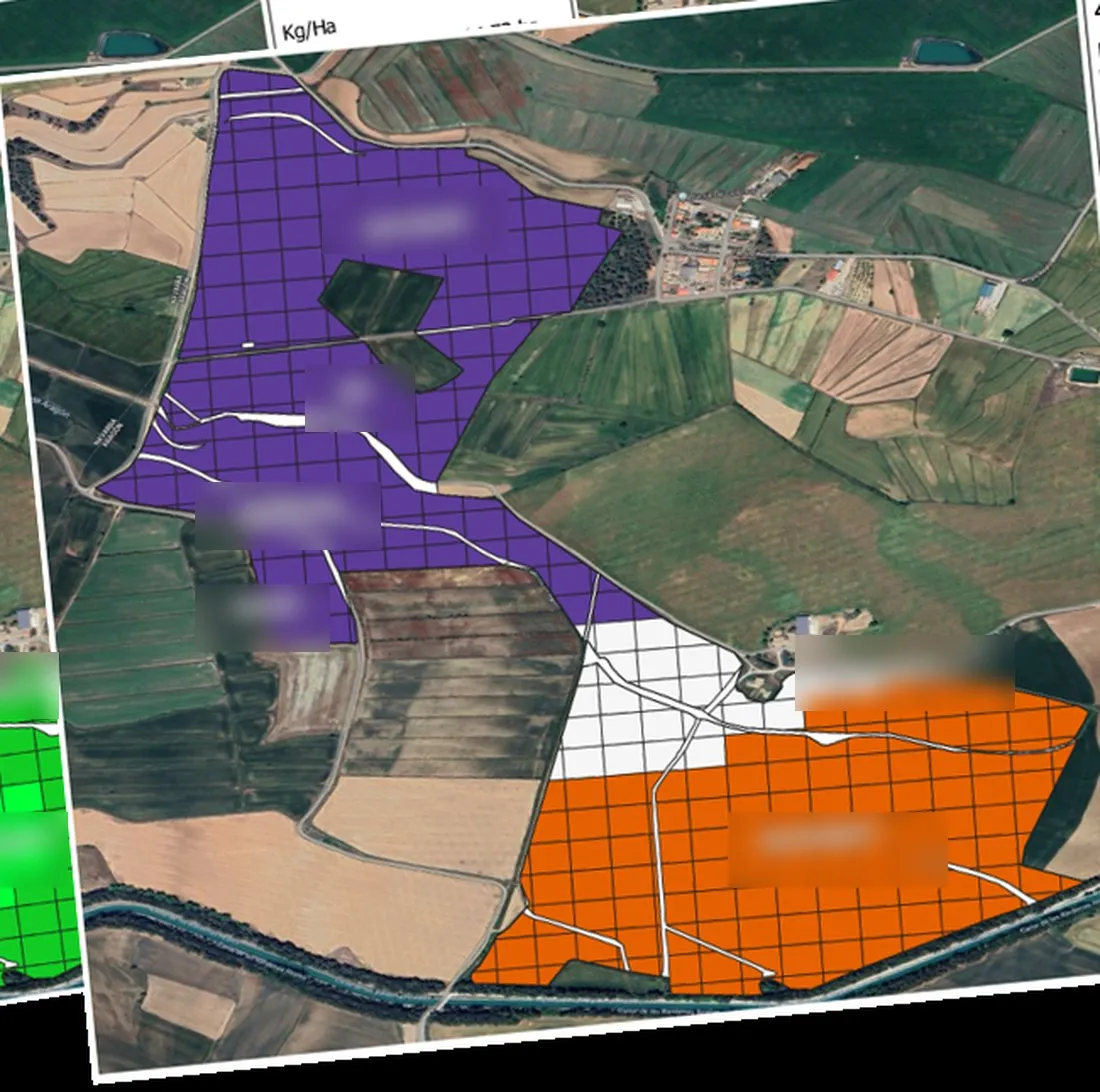
For a tractor that changes the rate by itself (variable rate). If you do not have one, most of the saving is still there with a single rate for the whole field.
The report
A practical one, with what to do. With Premium, also a full one, with the why.
Nothing to install. Nothing to learn. And no subscription: you pay for each analysis, that is all.
We take the samples and the laboratory is included. If you already have a soil test, send it to us and we return the interpretation, the balance, the plan and the variable rate map for your tractor. Tell us which method the laboratory used: we work with Mehlich-3, Olsen and Bray-1 results; if it used another, we tell you before you pay. Results in ppm or lb/acre are fine (lb/acre is about ppm × 2 for the top 15 cm / 6 in). In the UK, we work from the mg/l on your report and give you the index (0 to 6).
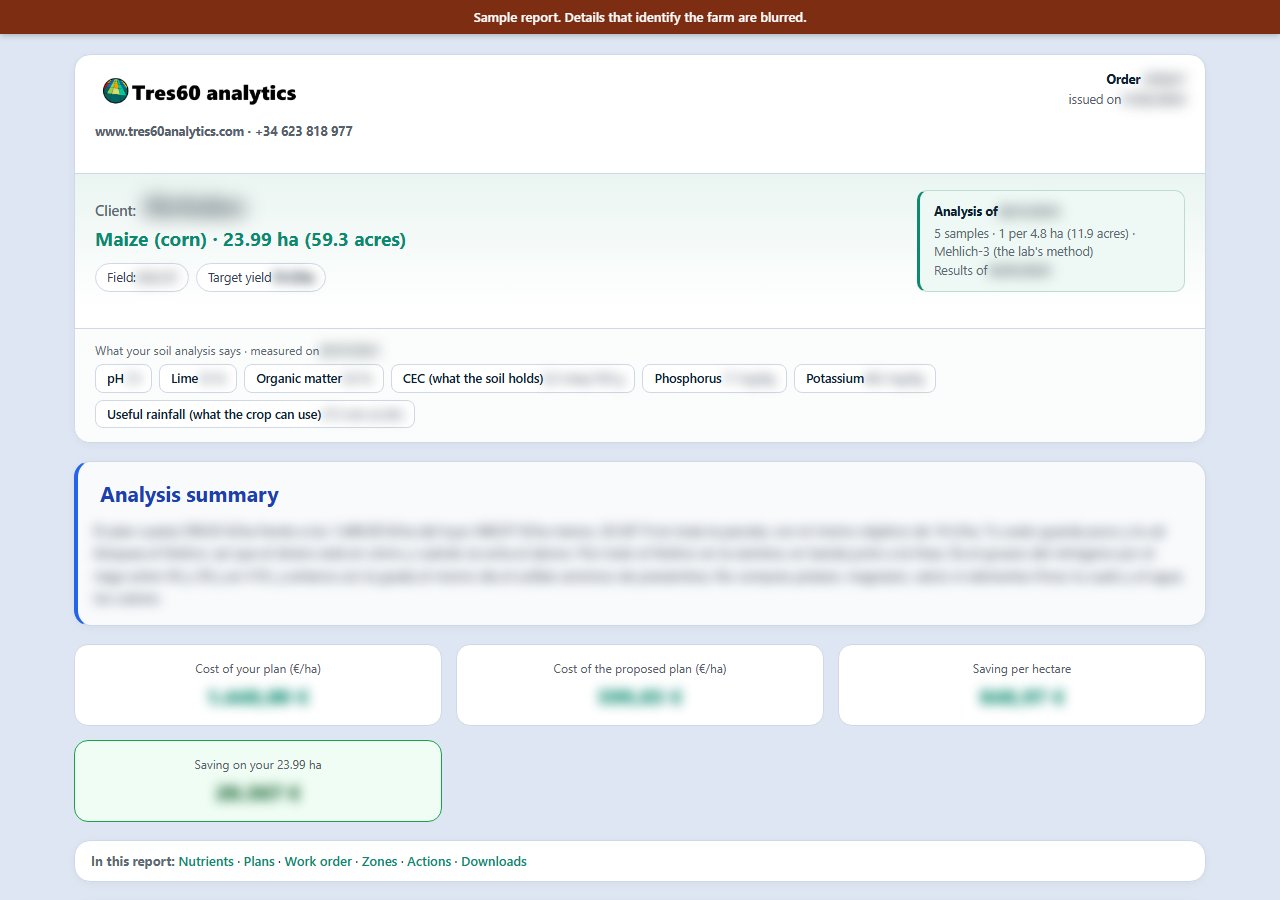
The sample report
A complete report, from start to finish, with its maps. Yours will look like this.
The analysis comes from a real farm. The farm and the client are not identified.
Two levels
The difference is not the amount of paper. It is the question each one answers.
When the field is even
How much fertilizer you are putting on that you do not need, and in which zones.
When the field is uneven
Why one part of your field yields less than another, and what to do in each zone.
Not sure whether your field is even? Start with Essential: the satellite will show you.
Two add-ons
They can be added to either level. They go into the calculation, they are not an appendix.
Your soil microbiome
It is what lives in the soil. Part of your fertilizer is not something you apply: the microbiome releases it. If it is switched off, you pay for all of it.
Irrigation water quality
If you irrigate, the water brings things in and also takes them away. Hard water changes the fertilizer plan; saline water changes it completely.

How often
Every three seasons
The soil test. There is no need to repeat it every year: the soil moves slowly.
Every year
The fertilizer plan. The target yield and the price of fertilizer do change every season.
That is why in the first year we analyse, and in the following years we only recalculate.
Start without paying
Send it to us. We tell you what you have too much of and what is missing, with numbers and without charging you anything. Then you decide.
Prefer to ask for a quote straight away? Write to us or see the prices.